Blue Ice - by Jökulsárlón, Iceland

9 Comments

Blue Ice - by Jökulsárlón, Iceland


Iceland has no shortage of surprises for guests on its glacial shores. Imagine you’ve been driving around route 1 with a portable hotel for days. You’ve been dazed by natural beauty and drama, and whipped by the same fresh winds that half-giants called home.

And yet, as you near back to where you started, there is plenty to stun and inspire.

Taking a step outside the hotel-mobile

Taking a step outside the hotel-mobile


The Jökulsárlón is an eery beautiful sight. Jökulsárlón litterally means “the glacier’s lagoon”, and it very much is. South of the lagoon, the sea, and North of it, the massive Vatnajökull glacier. Vatnajökull translates as “the glacier’s waters”, so you can see, Iceland is good with names. And “the glacier’s lagoon” is like no other.

Stillness, and a beach of black sand, surround the blue Ice

Stillness, and a beach of black sand, surround the blue Ice


The Vatnajökull glacier, ‘feeding’ water and ice to the lagoon’, is so huge that it covers almost a tenth of the entire island, and tops the ‘Europe’s hugest ice caps’ list by virtue of ‘most ice’. And while the ice is high up, far away from the tourist’s gaze, magic happens - then, it breaks, crashes or floats down, to appear a wonderful blue in the lagoon. Or black, if it is carrying volcano ash.

In the midst of a grey trip, the colours of Jökulsárlón stand out

In the midst of a grey trip, the colours of Jökulsárlón stand out


The quiet and cold around the lagoon are a great moveless spectacle. Birds fly here and there, and seals elegantly paddle by, but the stillness of the place makes one feel… silent. Any sound quickly dies, to leave its place with haste, to a cool, heavy, frozen silence. An absorbing, overpowering silence. A silence so deft, she could muffle her visitor in her palm, and slowly, unnoticed, take, and keep him.


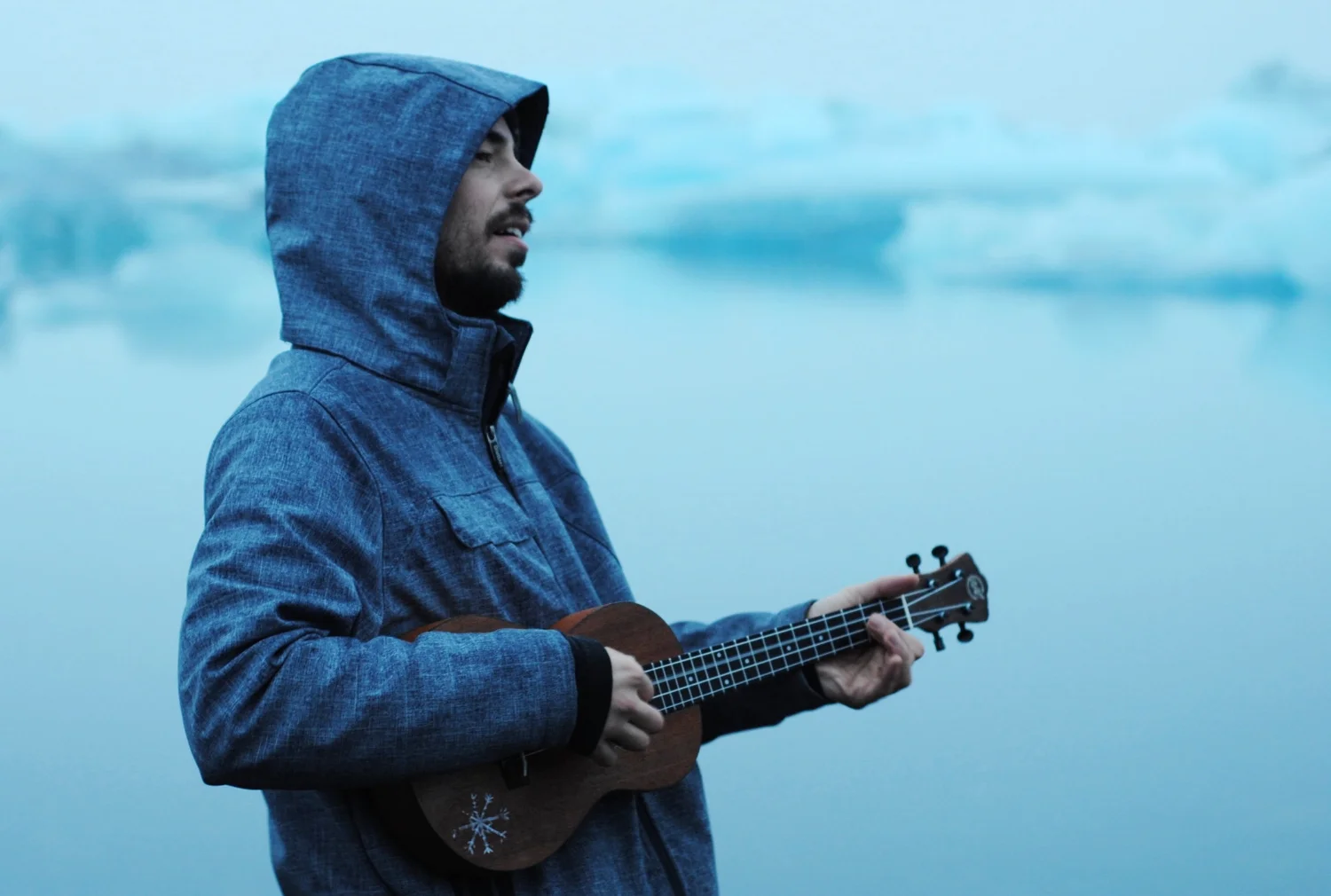
The beauty of the lagoon is not lost on too many, and funnily enough, all sorts have come here to make the most of this frozen sight. Movies (2 James Bond-ses!), music clips, adventurers with bad quality camcorders (see above)... Add to that, during the afternoon these ukes were there, a crew of heavily coat-ed guys from (probably) Japan, making a young pretty model do something silly, for the benefit of (probably) a new fragrance or a magazine’s signature hair colour.
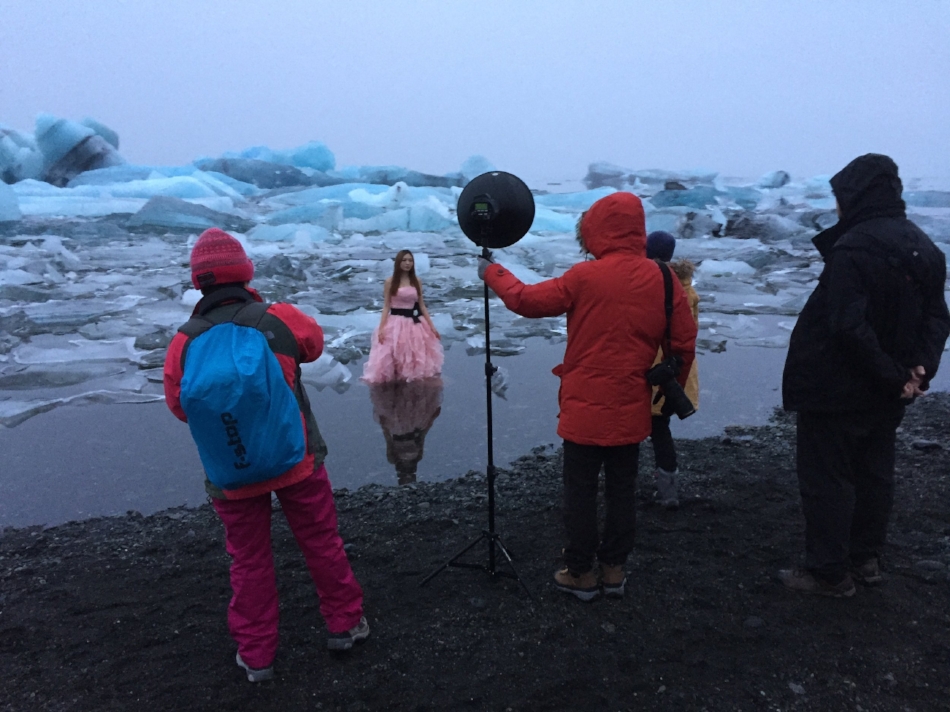
freeze frame technique

freeze frame technique


BEN’s BIT OF SCIENCE

WHY IS THE ICE BLUE ?

Basically, on the Vatnajökull, there is a whole lot of ice.

IMG-1323.jpg
 

All this ice creates massive pressure, or weight.

IMG-1325.jpg
 

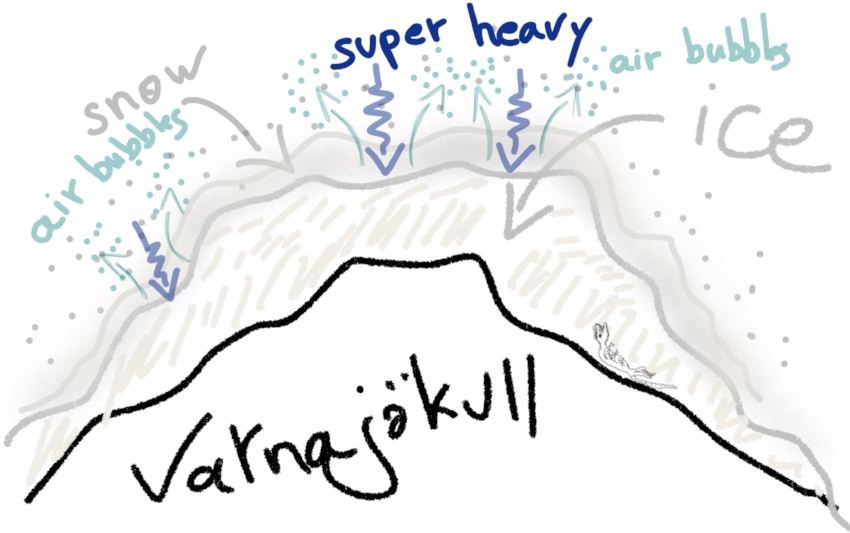
On occasion, when it snows, air bubbles are compressed out of the snow as it becomes part of the glacier. The ice created is then heavier, or denser.
IMG-1326.jpg
 

In this process, the ice crystals enlarge, meaning that the ice becomes better at absorbing colours. But not blue so much (an oxygen-hydrogen thing). So if it absorbs other colours than blue, it refracts, or sends back, more blue. So blue light bounces off of it and reaches our eyes. So it looks blue. So… it’s blue !!

Photograph of the Vatnajökull and lagoon, circa 1947, colourised (joke)

Photograph of the Vatnajökull and lagoon, circa 1947, colourised (joke)


HAS IT ALWAYS BEEN LIKE THIS? (UHM… NO, AND IT MIGHT NOT BE FOR LONG EITHER)

The Glacier’s lagoon wasn’t there a hundred years ago. Instead there was what can be called the glacier’s ‘tongue”’. It looks like a giant tongue. Of ice. Coming out of the glacier and leading towards the sea.

It was called Breiðamerkurjökull, meaning, wide thing marking where the glacier is (I guess).

As it all gets hotter starting in the 1920s (swing jazz and all that), things crack, melt and crash, and most of the tongue then leaves the lagoon in its wake, in 1935.

In 1979 it was 8 square kilometres big, but is now more than double that (18km²)! The speed at which the lagoon is growing is a witness to the heating up of the planet. And as you know, it’s not only swing jazz’s fault.

The beauty and uniqueness of the lagoon is that it changes daily. It is in a way a transition for the glacier’s water to flow back into the sea and is in constant secret motion. Never repeating itself in its icy sculptures.
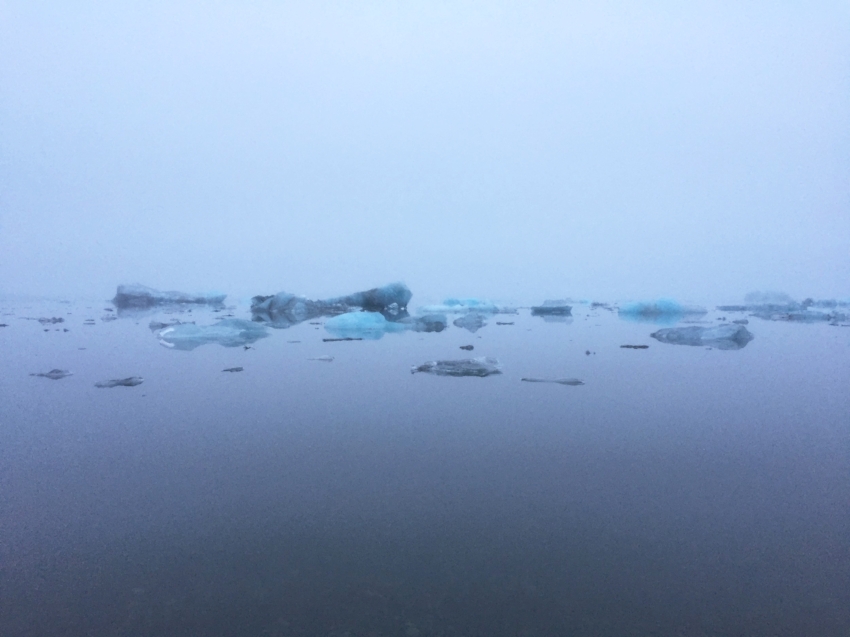
It take an iceberg about five years to go from ‘new lagoonee’ (or ‘freshwater freshman’) to being fully ‘sea graduate’.

It take an iceberg about five years to go from ‘new lagoonee’ (or ‘freshwater freshman’) to being fully ‘sea graduate’.


The silent, constant motion, is a marvellous, hypnotising one. However the rate at which this very motion is being quickened might well drastically change the location sooner rather than later. Hopefully we’ll fix the climate issue and the lagoon won’t have to be renamed the Jökulsfjörður.

Thanks for reading, and if you are one of the very very very few explorers to make it all the way down to these frosty depths of this post, hey, leave a comment!

This musical adventure through Iceland is made possible with the participation of the lovely and crazy people at awesome Kuku Campers, and with the participation of CloudMusic Ukuleles, which are the ukes you see me wandering and musing with here on the island!

9 Comments

The Northern Lights - Öxi Road, Iceland

3 Comments

The Northern Lights - Öxi Road, Iceland

Aurora Borealis: Lat. litt. the dawn of the (Going) North


Despite chasing Giants and hot springs on your Icelandic Road Trip, it is possible you may be surprised one quiet night by a different kind of sight. A sight which many visitors eagerly look forward to on this island.

Unexpectedly peering through the sky as you take a break outside from the late-night drive, 3 a.m. in the middle of nowhere, unannounced, they might just grace your adventure: the Northern Lights.

“What’s that light above the mountains there?”

“What’s that light above the mountains there?”


A fascinating dance of colours, a mystical display of flickering beauty, a graceful and inspiring stream of celestial photonic melodies,…

… none of those thoughts pass through my mind.

In the complete silence of a deserted gravel road, surrounded by mountains, I’m trying to understand what on Earth is happening. I only went out for a stretch. And in the dead of night, the sky is becoming lively.

“Oh! Wouo. What?”

“Oh! Wouo. What?”


The reason why an adventurer such as yourself may be taken aback under this rare blanket of light, is that it looks nothing like what you’d expect.

The tourist brochures have been lying to us! So drawing from my extremely limited experience, a few things need debunking, I find.

NOT WHAT YOU THOUGHT

THEY FLICKER

First off, they’re not still. They’re not like on the brochures. Which I understand cannot flicker. But these Northern Lights certainly do. The sky, in parts, flares up in flashes, light spreading across the canopy of night and stars. These travel like waves, conveyed by heart-beat, sending pulsating clarity to glide over the stillest landscape.

In other parts, the lights move like a cloud, slowly morphing, expanding or retracting. All this with a hint of fragility, as they can then disappear without the slightest notice.

NOT THAT NOISY

That one’s on me for subconsciously imagining a dancing sky would be accompanied by ‘swooshes’ ‘whoooshes’ and ‘vvvvvoooms’. They’re not. They’re really not. Transfixed by the eeriness above, the only sound you’ll hear for miles around, is your own boots on the gravel of the sleeping road. Crunch. Crunch crunch crunch. Crunch. And nothing more than silence.

THEY DON’T LOOK LIKE THIS:

Looks at camera’s screen. ”Whut?”

Looks at camera’s screen. ”Whut?”


They don’t look green. There’s a huge difference between how we’re used to seeing them in Instagram or on “Come See cool Iceland Stuff in a Packed Bus” brochures, and how they actually look.

That’s because the cells in our eyes that can detect fainter light (Rod cells) aren’t so good with colour, and the Aurora Borealis-es actually end up looking… GREY !

But (good) cameras pick up colours that we don’t see. Add to that the habit of Instagram and of the brochures to really up the saturation and contrast settings on their pictures after they’ve been taken, and you’ll see there really is a gap between what we’re ‘shown’, and what we ‘see’. A little example with my blurry picture:

My Instagram post with the caption “OMG Northern Lights so so green #beautiful”

My Instagram post with the caption “OMG Northern Lights so so green #beautiful”

What human eyes actually see. Also #beautiful.

What human eyes actually see. Also #beautiful.

At no point did I see green, blue, or see la vie en rose literally. However this may vary. If the sky is charged with colours enough that the bits in your head that see colour get switched on (that’s the eyes’ cone cells), then you may see certain colours with the Aurora. I guess. Not that I’ve seen it. An Icelandic lady who sold me postcards told me she saw purple ones a couple of times. That’s as reliable as my sources get.

So they’re grey. But, also maybe, colourful, if 1. you’re really really lucky 2. if you modify your memories through exposure to the souvenir photos you’ve taken 3. if you develop the ability to see beyond the usual spectrum of human eyes, like superman.

But why do they happen ? Why do the Northern Lights happen?

Ben’s BIT OF SCIENCE

We live on a planet called “Earth”. Lots of very exciting things are happening there, a few of which, I’ve tried to illustrate here.

Click on the picture to see all these exciting things close up


Our planet waltzes around everyone’s favourite star: the Sun! It’s quite hot.

IMG_1227.jpg
 

The Sun’s so hot, it goes on 365 dates a year with the Earth (badum tish). And it explodes a lot. And sends deadly solar wind our way at the end of the meal.

But our planet’s pretty hot too! Inside it, there’s some molten (melted) iron in constant fusion! Hot.

IMG_1224.jpg
 

Luckily for life, giant Eagles and musical adventures, this molten (red hot) iron creates a magnetic shield. A bit like a ukulele bag for when it’s snowing. And this enables us to stay alive. Which is quite handy.

IMG_1222.jpg
 

However, the shield is weaker at the magnetic poles (top and bottom of Home).

Meaning the sun’s radioactive storms -ions and electrons shooting through space- can sort of get through a bit over there as you get closer to the North and South end bits.

IMG_1230.jpg
 

As the sunny electrons fizz (silently) into our atmosphere, they rub and tango with molecules in the air (oxygen and nitrogen). The air’s molecules, rattled by the dance, then have to relieve the extra energy by emitting photons. Which we call light! The type of light emitted by the molecules varies according to altitude and ratio of gases present, and these variables are behind the different colours of the Aurora… that your camera can see.

If all this happens in the Northern bit of the planet, these photons then hit the rods (and if they’re lucky, maybe the cones too) at the back of the eyes of an adventurer or two, who then exclaim “Oh! Wow, I think it’s the Northern Lights!”

That is where the famous expression “Hit the rods, Jack” comes from.

A wave of Light. The Silent Sky, just like it seemed to me, as it hit the rods

A wave of Light. The Silent Sky, just like it seemed to me, as it hit the rods


The Aurora Borealis, are, subjectively, fascinating to experience, but not necessarily for the (colourful) reasons they are such a sought-after sight. Rather than a dazzling dance of colours, they are a touching tribute to how little we know, or notice, about our everyday reality.

The particles shooting above Iceland, are shooting all across the solar system and beyond, every single second. We are also unknowingly bombarded by millions of particles, wherever we are sat or standing, whatever we are doing, despite the magnetosphere. It’s just that comparatively with how much is happening, our sense of sight operates on a pretty limited range.

And seeing the sky flicker, standing underneath thousand of stars a late night in Iceland is, most of all, an inspiring reminder to how much unseen drama is actually going on everywhere, always.

DSC_0807.JPG
 

Imagine if I had a really good camera ? This article would have been amazin’. The drawings are top shelf though.

Thanks a lot for reading. Btw, scribbled in the top shelf drawings, are references to 6 Going North other destinations and songs. Do you recognise any of them ? Do tell #sayinthecomments #drawin-skillz

This lucky adventure of light and sound is propelled by Kuku campers, the nicest peoples with vans and cars that you can rent, and CloudMusic Ukuleles, whose hearty ukuleles I strum along the cold adventure. But not during Northern Lights. I just look when those happen.

3 Comments

Hraesvelg and the Ash - Eyjafjörður, Iceland

1 Comment

Hraesvelg and the Ash - Eyjafjörður, Iceland


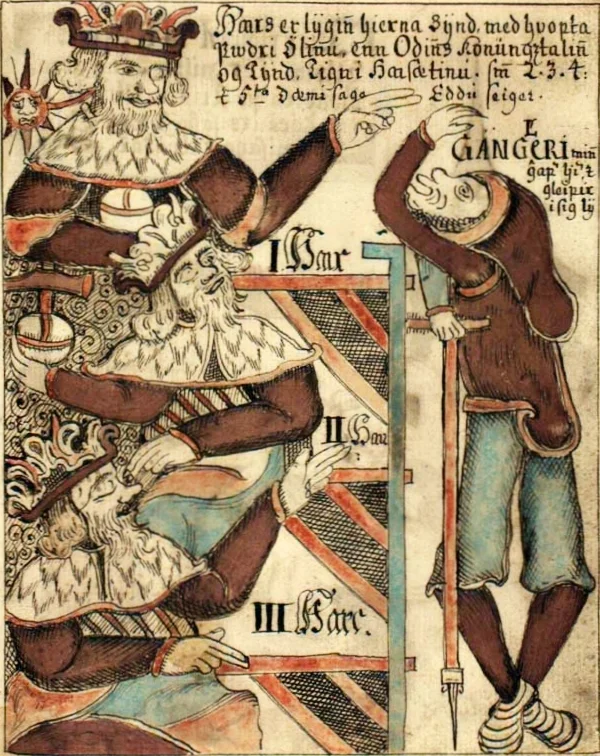
King Gylfi, still disguised as Gangleri, persists in his efforts. He aims to obtain as much information from the great Trinity of Gods as his trickery can muster. It's not everyday you get to chat with the masters of the cosmos (High, Just-as-High, and Third in case you forgot).

High, Just-As-High, & Third (Hár, Jafnhár, & Þriði) and Gangleri, deep in conversation (Icelandic comic strip, XVIIIth c.)

High, Just-As-High, & Third (Hár, Jafnhár, & Þriði) and Gangleri, deep in conversation (Icelandic comic strip, XVIIIth c.)


After hearing about the universe and creation, Gangleri finally asks a question on the lips of all travellers having braved the harsh Icelandic elements.

Whence comes the wind? It is so strong that it whips the great oceans and stirs up fire. But as strong as it is, no one can see it. It is so wondrously made.

'The Wind! Sometimes it's there, sometimes not. Where does it come from?' Gangleri scratches beard ponderously

'The Wind! Sometimes it's there, sometimes not. Where does it come from?' Gangleri scratches beard ponderously


Then High answered 'That I can tell you well. At the far Northern end of Heaven, sits a Giant named Hraesvelg. He is clad in eagle's feathers. And when he beats his wings to take flight, the winds arise from under them. (The Prose Edda 18.)


And so, from the northernmost part of the cosmos, Hraesvelg, 'who knows many things', sends gusts of wind rushing onto the bare Icelandic mountains. Carving the landscape even as did the sons of Bor. 

"Hraesvelg, he is called,

who sits at Heaven's End

a Giant in Eagle's shape.

From his wings it is said, the Winds

blow over all men"

(The Sybil's Prophecy. 37)

Rare stillness. A gift from the Giant in Eagle's shape

Rare stillness. A gift from the Giant in Eagle's shape


However, the Scandinavian scriptures tell us, Hraesvelg is not alone on the edge of the universe (which, as everyone knows, is a big tree). Between his eyes rests a hawk, Veðrfölnir, 'wind-bleached' clear and bright. Not to be confused with Odin's ravens discussed in the podcast...

And one shouldn't imagine that the feathered friends are undisturbed...

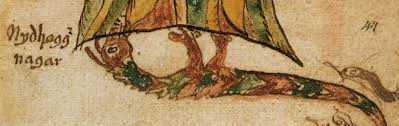
The cosmos-tree Yggdrasil leads with its roots down to three planes: the divine one, the one where matter was formed, and the evil one (respectively Æsir, 'where Ginnungagap used to be', and Niflheim). And underneath the lowest root, there where serpents abide, the monster Nidhogg gnaws at Yggdrasil. Meaning, he's biting the roots of it. Which is most probably very unpleasant for the Tree.

Munch, munch...

Munch, munch...


Between this lowest plane where the munching goes on, and heaven's end, a squirrelRatatosk is up to all kinds of mischief. He carries 'gossip and insults' between our winged giant and the evil monster. Yes, really. A gossiping squirrel. But to be fair to him, older sources than the very recent Prose Edda (XIIIth c.) state simply that:

'Ratatosk is the squirrel who there shall run, On the ash-tree Yggdrasil; From above the words of the eagle he bears, And tells them to Nidhogg beneath.' (Grímnismál - Poetic Edda)

Which is more straightforward and less controversial for our little friend.

In the midst of the branches, four stags rummage around 'devouring the tree's foliage'. But hey. Stags do what stags do. It's a stag's dues. There's  no stag don'ts. Just ... yes you got it. And the lads are: Dáinn, Dvalinn, Duneyrr and Duraþrór.

See if you can identify this merry band of beasts...

the whole picture.png
 

Although, actually, the god 'High' is frustratingly unclear about one point: whether Hraesvelg is that same eagle, or, if a separate eagle, non-wind-related, sits up there with a hawk between his eyes. Which would mean there would be two. So a total of four eagle wings. And lots more feathers.

This is up for debate amongst animal-scholars, and I'm just glad I got to bring up the squirrel.

Surely wider concepts hide here in the branches of Yggdrasil. Do you see in it the cosmos, a metaphor for the body, or an Scandinavian's very creative prose?

Interestingly, this representation may have been on a Road Trip of its own. These concepts seem to echo Euro-Asian mythology (see the eagle Garuda who triumphs over serpents, or also the serpent-like kundalini, both from the Hindu faith) and may have been influenced by it, as well as by Christian imagery, say the above-mentioned scholars. The disrupting serpent-beast Nidhogg resonates quite well also with the one who tempted Adam and Eve to fall out of Heaven. Food for thought no doubt. 

All in all, noble creatures and restless beasts, grace, threaten and defend the great tree of life Yggdrasil. But, it is near impossible to picture any of it being the truth behind our reality, when faced with the calm beauty of an early evening by the fjords of Eyjafjörður.

Calmness still spread over the Eyjafjörður

Calmness still spread over the Eyjafjörður


Thanks for reading/viewing! If you've made this far, do drop a comment! It's fantastic to know when (if?) someone actually makes it through the whole thing. May Hraesvelg's mighty winds arrive to you as light guiding breezes.

The drawings in this post are from the manuscripts here (XVIIIth c.) and here (XVIIth c.). Feel free to click ahead and practice ye olde Icelandic.

This musical adventure through Iceland is made possible with the participation of the lovely and crazy people at awesome Kuku Campers, and with the participation of CloudMusic Ukuleles, which are the ukes you see me wandering and musing with here on the island!
The edge of the Fjord and a view on the bridge leading to Akureyri

The edge of the Fjord and a view on the bridge leading to Akureyri


1 Comment